
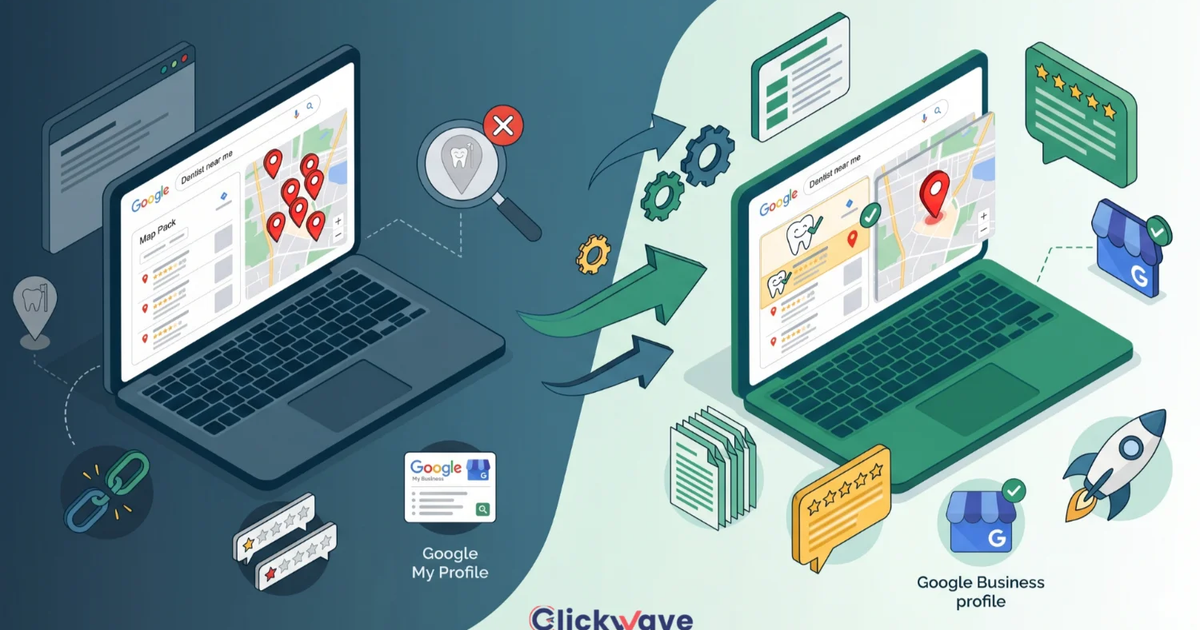
Why Local SEO Is the Highest-ROI Marketing Channel for Dental Practices
Unlike paid search advertising, which stops generating traffic the moment a budget runs out, local SEO builds compounding visibility that works continuously without per-click cost. A dental practice that ranks in the top three Google Maps positions for 'dentist near me' in its city will generate a predictable volume of new patient inquiries every month, year after year, without paying for each click.
The practices that dominate local search in competitive dental markets did not get there by accident. They built that visibility through a deliberate combination of Google Business Profile optimization, website alignment, citation management, review generation, and local content. This Clickwave guide covers each of those components in the context of what works in 2025.
How Local Search Rankings Work for Dental Practices
Google evaluates dental practices for local rankings using three primary signals. Relevance measures how well your profile and website content match what the patient is searching for. Proximity measures the physical distance between your practice location and the patient performing the search. Prominence measures how well-known and trusted your practice appears to be across the web, based on reviews, citations, inbound links, and content.
Proximity is the only factor you cannot control. Relevance and prominence are built deliberately over time, which means two practices in the same neighborhood can have dramatically different local rankings based entirely on their SEO investment.
Step 1: Google Business Profile Optimization
Your Google Business Profile is the most influential single asset in local dental SEO. It determines whether you appear in the Local Pack at all, and how prominently you appear when you do.
Complete every available field. Business name, address, and phone number must match exactly what appears on your website and across all directory listings. Select the most accurate primary category for your practice type. Add all applicable secondary categories such as cosmetic dentist, pediatric dentist, or emergency dental service if they apply to your service mix.
Write a business description that incorporates your primary service keywords and geographic identifiers naturally within the first two hundred and fifty characters. Upload a minimum of twenty photos covering your exterior, reception area, treatment rooms, and clinical team. Add your complete list of services with descriptions. Post updates at least twice per month to maintain freshness signals.
Step 2: On-Page Local SEO for Your Website
Your website needs to signal to Google that it belongs in local search results for dental queries in your specific geography. That requires three things: location-targeted title tags and meta descriptions on all primary pages, a properly structured local business schema markup that tells Google your NAP data in machine-readable format, and genuine geographic content that references your city, neighborhood, and surrounding service areas naturally within your copy.
Each core service you offer should have a dedicated page that includes the service name and your city in the title tag, a thorough description of the treatment and patient experience, and a clear call to action. Generic service pages that cover every treatment in a single paragraph are a structural SEO disadvantage. Specific, comprehensive pages outrank thin pages consistently.
Step 3: Citations and Directory Listings
A citation is any online reference to your practice's name, address, and phone number. Google uses citations to verify that your practice is a legitimate, established business at the location you claim. Inconsistent citations, where your practice name or address appears differently across different platforms, create conflicting signals that suppress local rankings.
Priority citation sources for dental practices include Google Business Profile, Apple Maps, Bing Places, Yelp, Healthgrades, Zocdoc, WebMD, Vitals, the American Dental Association directory, your state dental association, and local chamber of commerce listings. Each of these should display identical NAP information. An annual audit to catch and correct inconsistencies is a standard component of ongoing local SEO maintenance.
Step 4: Review Generation and Management
Review volume, recency, and response rate are all ranking factors in local search. A practice with eighty reviews acquired over the past two years will typically outrank a competitor with fifty reviews from three to five years ago, all else being equal. More importantly, patients making a first-time dental appointment read reviews before calling. Practices with fewer than twenty reviews or a rating below four stars lose patients to competitors before the first contact is ever made.
The most effective review generation approach is a systematic post-visit follow-up, sent as a text message within twenty-four hours of an appointment, with a direct link to your Google review page. Reduce the number of steps between the patient's intention to leave a review and the submission of that review to as close to one as possible. Practices that automate this process through their practice management software or a tool like Birdeye or Podium generate reviews consistently without relying on individual staff members to remember to ask.
Step 5: Local Link Building
Inbound links from other local websites function as endorsements of your practice's relevance and authority in your geographic area. The highest-value local links for dental practices typically come from local news coverage of community events or patient stories, sponsorships of local schools, sports teams, or charitable organizations where the sponsoring organization links back to your website, listings in local business directories with individual website links, and partnerships with complementary healthcare providers such as orthodontists, oral surgeons, or pediatric practices that refer to each other.
Local link building does not require large volumes of links. A handful of genuine, high-authority local citations and links outperforms dozens of generic directory submissions in terms of ranking impact.
Step 6: Tracking Your Local SEO Progress
Local SEO without measurement is guesswork. At minimum, track your Google Business Profile Insights monthly, including the number of searches that surface your profile, the number of website clicks, direction requests, and phone calls generated. Track your website's organic traffic by source and monitor keyword rankings for your primary target phrases using a tool like BrightLocal, Semrush, or Google Search Console.
Expect meaningful ranking movement to take three to six months for a well-optimized profile in a mid-competition market, and six to twelve months in highly competitive urban markets. The compounding nature of local SEO means that the practices investing consistently today are building an advantage that will be difficult for new competitors to close quickly.
Common Mistakes Dental Practices Make With Local SEO
- Using keyword-stuffed business names on Google Business Profile, which violates Google's terms of service and can result in suspension of the listing.
- Neglecting to respond to negative reviews, which signals to prospective patients that the practice is unresponsive to concerns.
- Allowing NAP inconsistencies to accumulate across directories for years without an audit.
- Creating service pages that are identical across multiple practice locations without location-specific customization.
- Assuming that paid Google Ads campaigns improve organic or Maps rankings, as they do not.
Frequently Asked Questions
How long does local SEO take to show results for a dental practice?
Initial ranking improvements in lower-competition markets can be visible within six to eight weeks of a thorough optimization effort. In competitive markets, expect three to six months before meaningful movement in the Local Pack and six to twelve months before stable top-three rankings for primary search terms.
Is local SEO worth it compared to Google Ads for a dental practice?
Both serve different purposes. Google Ads provides immediate visibility and is valuable for new practices or during periods of growth. Local SEO builds durable organic visibility that does not require per-click spend. The highest-performing practices use both in parallel, using paid search to generate immediate patients while investing in organic local rankings for long-term cost efficiency.
How important are reviews compared to the other ranking factors?
Reviews are among the most consistent and measurable local ranking factors. In competitive markets, review volume and recency can be the deciding difference between two practices with otherwise similar profiles and websites.
Do I need a separate Google Business Profile for each location?
Yes. Each physical practice location requires its own verified Google Business Profile. Managing multiple locations requires a more structured approach to NAP consistency and review management, but each location can rank independently in its own geographic area.
Ready to build dominant local search visibility for your dental practice? Contact us for a local SEO strategy consultation tailored to your market.